
Guides & Articles
What is Remote Production (REMI) and How to Choose the Right Hardware
Remote production—also referred to as REMI, REMote Integration, or at-home production—is a workflow in which live event content is captured and sent via IP links to a centralized production facility where the final program is produced and distributed.
While some live events may reign supreme among traditional TV audiences, advances in broadcast technology are paving the way for more diversified live online content. As the demand for live events continues to grow, so does the need for broadcasters to produce content that’s as thrilling and action-packed as the concert, game, or competition itself—all while minimizing costs and maximizing resources.
REMI Workflows
Remote production (REMI) for live, multi-camera events is gaining momentum, with workflow approaches including in-studio and cloud-based production.
In-studio production
In-studio live production involves encoding Serial Digital Interface (SDI) feeds in the field, transporting them to the studio over IP, and converting them back to SDI feeds. Traditional SDI-based systems manage and produce content as if the cameras were within the same facility as the production crew. With REMI, broadcasters can leverage a single production system to work on multiple events in different venues rather than sending an OB truck, crew, and equipment to each event.
Cloud-based production
Cloud-based production involves live production migration from systems on-premises to cloud-based platforms where they can be offered as Software as a service (SaaS). The SDI feeds in the field are encoded and streamed to platforms where produced feeds are fed to cloud-based Over-the-Top (OTT) delivery platforms.
Why Hardware Encoders are Critical for REMI
While software solutions (like OBS) exist for hobbyists, professional broadcast workflows demand dedicated hardware. The Matrox Monarch EDGE Series offers distinct advantages for live events:
- Ultra-Low Latency: Achieve glass-to-glass speeds as low as 100ms.
- Synchronization: Built-in Genlock ensures all remote cameras stay perfectly in phase.
- Bi-Directional Communication: Integrated Tally and Talkback allow the studio to direct camera operators in real-time.
- 4:2:2 10-Bit Color: Maintain broadcast-grade color depth for post-production and grading.
Top 5 Benefits of Remote Production
Remote production can improve how broadcasters work, allocate resources, and manage teams. Here are five reasons why broadcasters should consider REMI.

Reduce costs
With less headcount and satellite trucks and OB vans travelling back and forth, you can keep your resources in-house to reduce costly travel and shipping expenses.

Leverage existing infrastructure
Use existing infrastructure to produce live events by transmitting SRT and ST 2110 streams. to your control centers and thus scale back on the infrastructure needed on premise.

Improve agility and flexibility
Create unique workflows by accessing a deeper pool of talent and capabilities, allocating resources more efficiently, and enabling more people to work remotely.

Remove geographic barriers
Remove geographic limitations and improve remote collaboration, so hosts, guests, correspondents, and staff can be located anywhere.

Deliver more live content
Remove geographic limitations and improve remote collaboration, so hosts, guests, correspondents, and staff can be located anywhere.
Remote Production (REMI) FAQs
How much latency does a REMI workflow introduce?
While traditional satellite links have delays, modern broadcast hardware encoders like the Matrox Monarch EDGE can achieve glass-to-glass latency as low as 100ms. This ultra-low latency is critical for bi-directional interviews and live sports where timing is everything.
Can I use the public internet for broadcast contribution?
Yes. By using an encoder with SRT (Secure Reliable Transport) protocol support, you can send high-quality, encrypted video over unpredictable public networks with low latency. SRT recovers lost packets to ensure a stable stream, making it ideal for at-home production in regions with varying connectivity.
How do I keep multi-camera remote feeds in sync?
Synchronization in REMI workflows is handled by Genlock. A professional hardware encoder should accept a Genlock signal to ensure all cameras are phase-aligned. The Matrox Monarch EDGE supports genlock to keep your remote feeds perfectly synchronized with your studio production switcher.
What bandwidth is required for 4K remote production?
Bandwidth requirements depend on the codec. Using efficient HEVC (H.265) hardware encoding allows you to transmit pristine 4K UHD video at much lower bitrates than H.264, making high-quality remote production possible even on standard internet connections.
Do I need a dedicated hardware encoder or can I use software?
While software is suitable for basic streaming, broadcast hardware encoders offer dedicated processing power for reliability, 4:2:2 10-bit color depth, and features like Tally and Talkback that software often lacks. For mission-critical live events, hardware is the standard.
Questions about remote production?
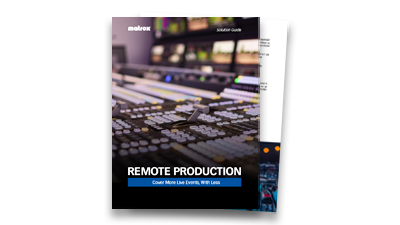
Learn how the right REMI solution provides the flexibility to cover more live events with less resources. In this guide we explore:
- Key market trends and areas of future opportunity.
- The benefits and challenges of remote production models.
- Real-world examples of customer success.
Ready to build your REMI workflow?
Get a personal demo of the Monarch EDGE encoder and see how it handles low-latency transport.